On the Relationship Between the Process of State-Building and the Achievement of a Strong State from the Perspective of the Thinker Fukuyama: Iraq as a Case Study
Keywords:
Rule of Law; State Building; Effective Institutions; Legitimacy and Sovereignty; Democratic Transformation.Abstract
This study examines the problem of the state in Iraq within the framework of state-building and the concept of the effective state. It proceeds from the assumption that weak and failed states suffer from structural deficiencies in the process of state-building, making them a source of serious political, security, and economic challenges. Iraq represents a significant case of this dilemma, particularly in light of the profound transformations that have occurred since 2003 and the accompanying challenges related to legitimacy, sovereignty, institution-building, and political stability.
The study seeks to analyze the reality of the Iraqi state by addressing the nature of the state in Iraq, identifying its position within the stages of state-building, and examining the possibility of transforming it into an effective and strong state despite the complex internal and external circumstances. It also discusses the various classifications applied to Iraq, including fragile, weak, and failed state, and attempts to determine its actual status within the state-building process.
The study draws on Francis Fukuyama's ideas concerning state-building, emphasizing the importance of effective institutions, the rule of law, state legitimacy and sovereignty, and the enhancement of state capacity and efficiency in performing its core functions. The study concludes that building an effective Iraqi state requires a comprehensive institutional and legal project based on strengthening state institutions, consolidating the rule of law, and promoting democratic transformation and sustainable development to ensure political and social stability.
Downloads
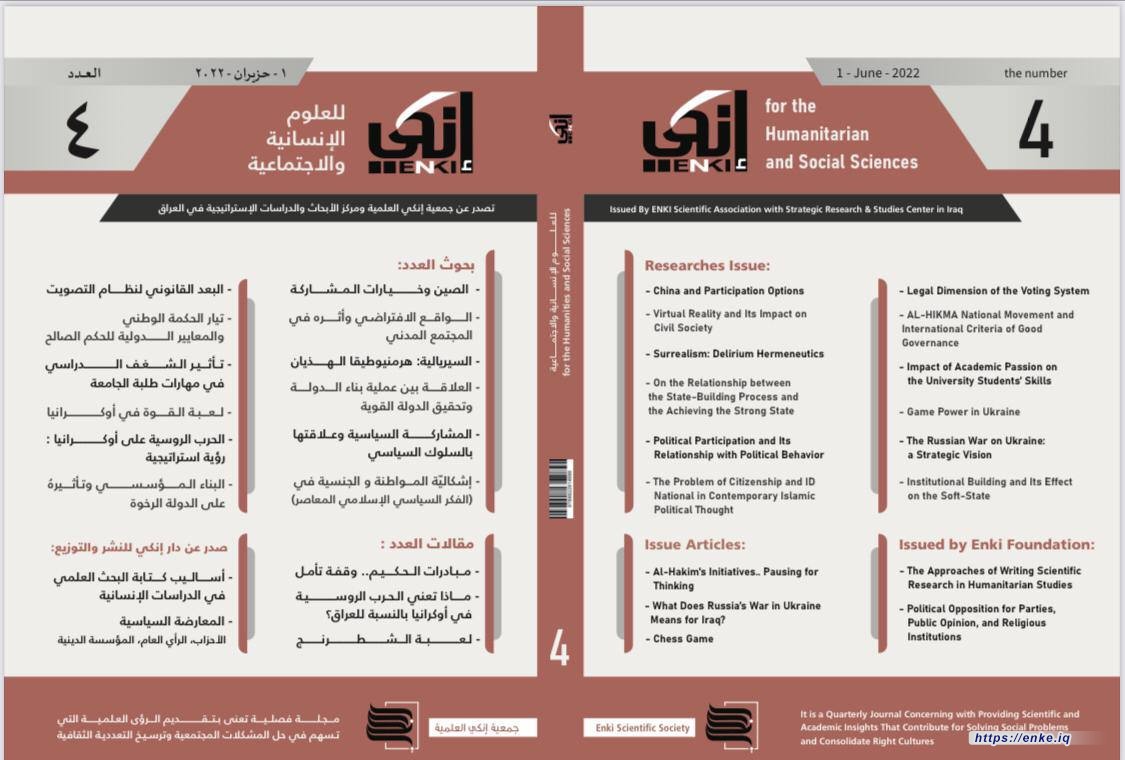
Downloads
Published
Issue
Section
License
Enki Journal for Humanities and Social Sciences is an open access journal. All content is free to read and download immediately upon publication, without fees or registration. Authors retain copyright in their published work and grant the journal the right of first publication.
This work is licensed under a Creative Commons Attribution 4.0 International License (CC BY 4.0). Anyone may copy and redistribute the material in any medium or format, and adapt and build upon it for any purpose, including commercial use, provided that appropriate credit is given to the author(s) and the original source (Enki Journal for Humanities and Social Sciences), a link to the license is provided, and any changes are indicated.
Full license text: https://creativecommons.org/licenses/by/4.0/