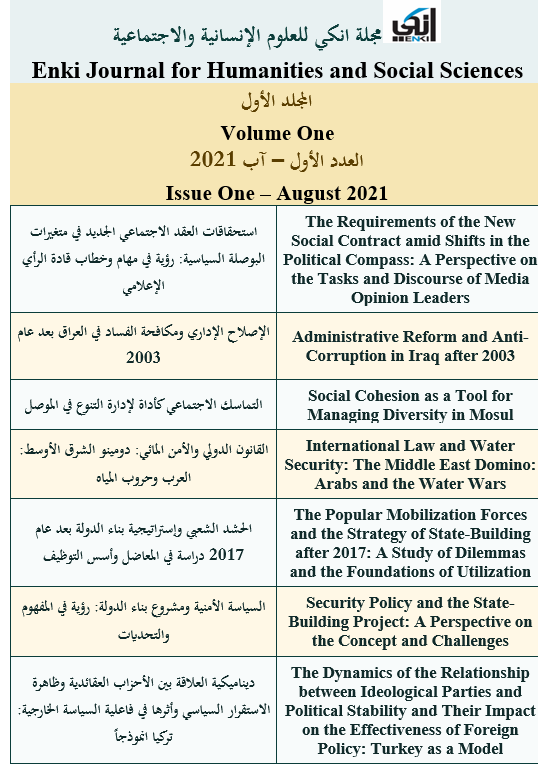
Security Policy and State-Building: A Conceptual and Challenge-Based Perspective
Keywords:
Security Policy, State-Building, National Security, Strategic Planning, Security Institutions.Abstract
This study examines security policy as a central approach to state-building and the consolidation of national stability. It analyzes the concepts of policy and the state, identifies the nature and functions of security policy, and explains its role in protecting national and state security. The study is based on the assumption that state-building cannot be achieved through political and administrative tools alone; rather, it requires an effective security system capable of formulating security commitments, mobilizing state capacities, and organizing security practices to confront internal and external threats.
The study highlights the Iraqi experience in national security after 2003 and the challenges associated with terrorism, institutional weakness, and the need to develop security and strategic planning on scientific and professional foundations. It concludes that the success of security policy depends on the decision-maker’s ability to employ available resources, strengthen coordination among security institutions, and rely on scientific research and research centers in preparing plans and strategies. Contemporary security is no longer limited to the military sphere; it has become a comprehensive system that integrates political, economic, social, and media dimensions, making it a fundamental condition for building a citizenship-based state, the rule of law, and public stability.