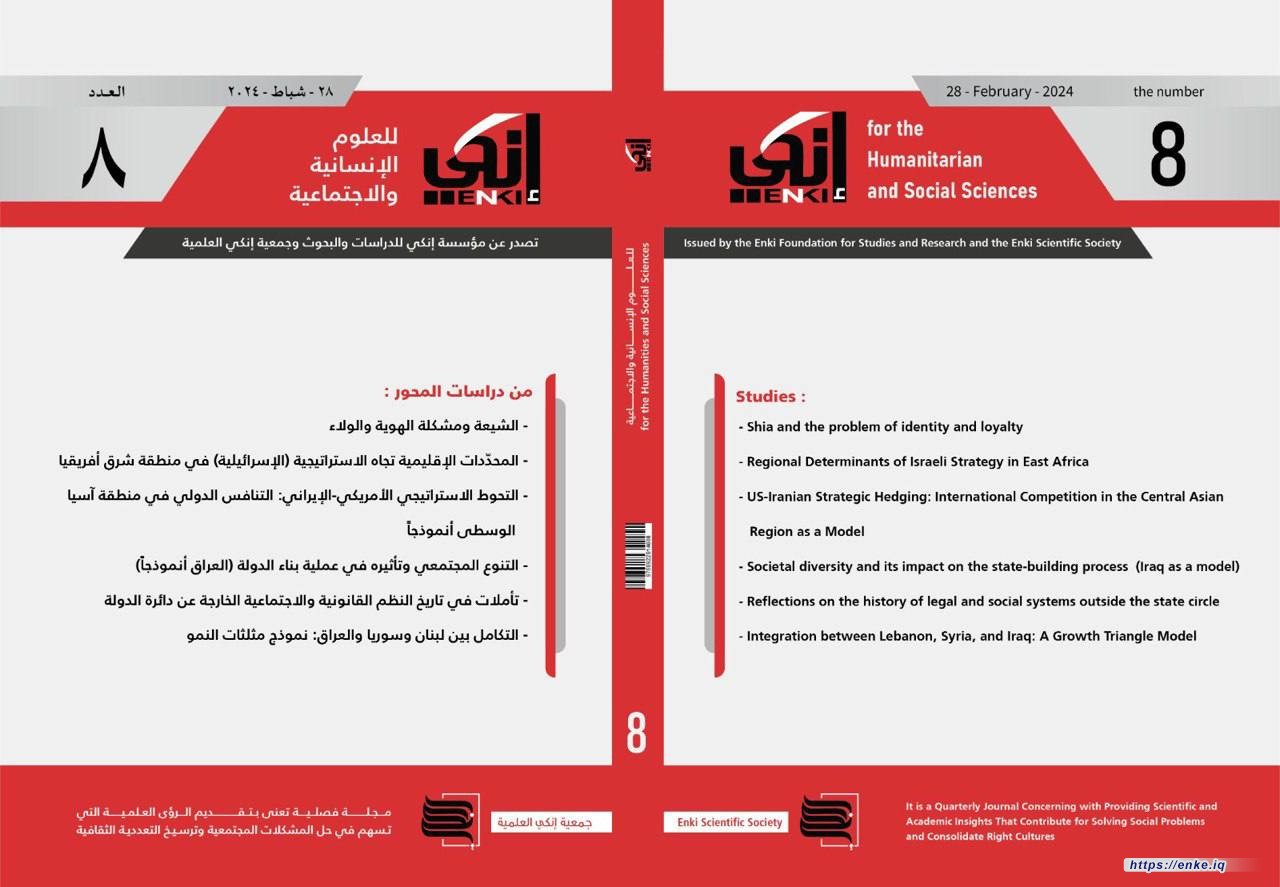
Regional determinants towards the (Israeli)strategy in east Africa
Keywords:
turkey, Iran, east Africa, Israel.Abstract
The east African region, which includes (Somalia, Ethiopia, Eritrea, Djibouti, Sudan, south Sudan, Uganda, and Kenya), is of great importance to the regional countries (Iran and turkey), as its importance appears because of the weight of its voices in the region. It also overlooks the most important waterways represented by the red sea from Eritrea, Djibouti and Somalia, as the red sea connects the Mediterranean sea to the Indian ocean through the Suez canal in the Abstract The East African region, which includes (Somalia, Ethiopia, Eritrea, Djibouti, Sudan, South Sudan, Uganda and Kenya), is of great importance to the regional countries (Iran and Turkey), as its importance appears because of the weight of its voices in the region. It also overlooks the most important waterways represented by the Red Sea from Eritrea, Djibouti and Somalia, as the Red Sea connects the Mediterranean Sea to the Indian Ocean through the Suez Canal in the north and the Bab al-Man dab Strait in the south, and from that It was of great importance in the Iranian strategy, in which it saw the exit gate to the world through international waters (the Red Sea, the Indian Ocean, and the Gulf of Aden), in addition to the economic resources contained in the region. Iran’s endeavor for a military and security presence to promote its regional goals by establishing a network of cooperation with the countries of the region and in several fields. Turkey, which enjoys great influence in the East African region, is of great importance. This strategy is due to the waterways they contain of commercial and military importance and economic resources. Thus, Ankara worked to open broader areas for economic and investment cooperation, as it worked through its diplomatic activity to open Relations with East African countries to expand its presence as part of its strategy to play an active regional role.
Downloads
Downloads
Published
Issue
Section
License
Enki Journal for Humanities and Social Sciences is an open access journal. All content is free to read and download immediately upon publication, without fees or registration. Authors retain copyright in their published work and grant the journal the right of first publication.
This work is licensed under a Creative Commons Attribution 4.0 International License (CC BY 4.0). Anyone may copy and redistribute the material in any medium or format, and adapt and build upon it for any purpose, including commercial use, provided that appropriate credit is given to the author(s) and the original source (Enki Journal for Humanities and Social Sciences), a link to the license is provided, and any changes are indicated.
Full license text: https://creativecommons.org/licenses/by/4.0/