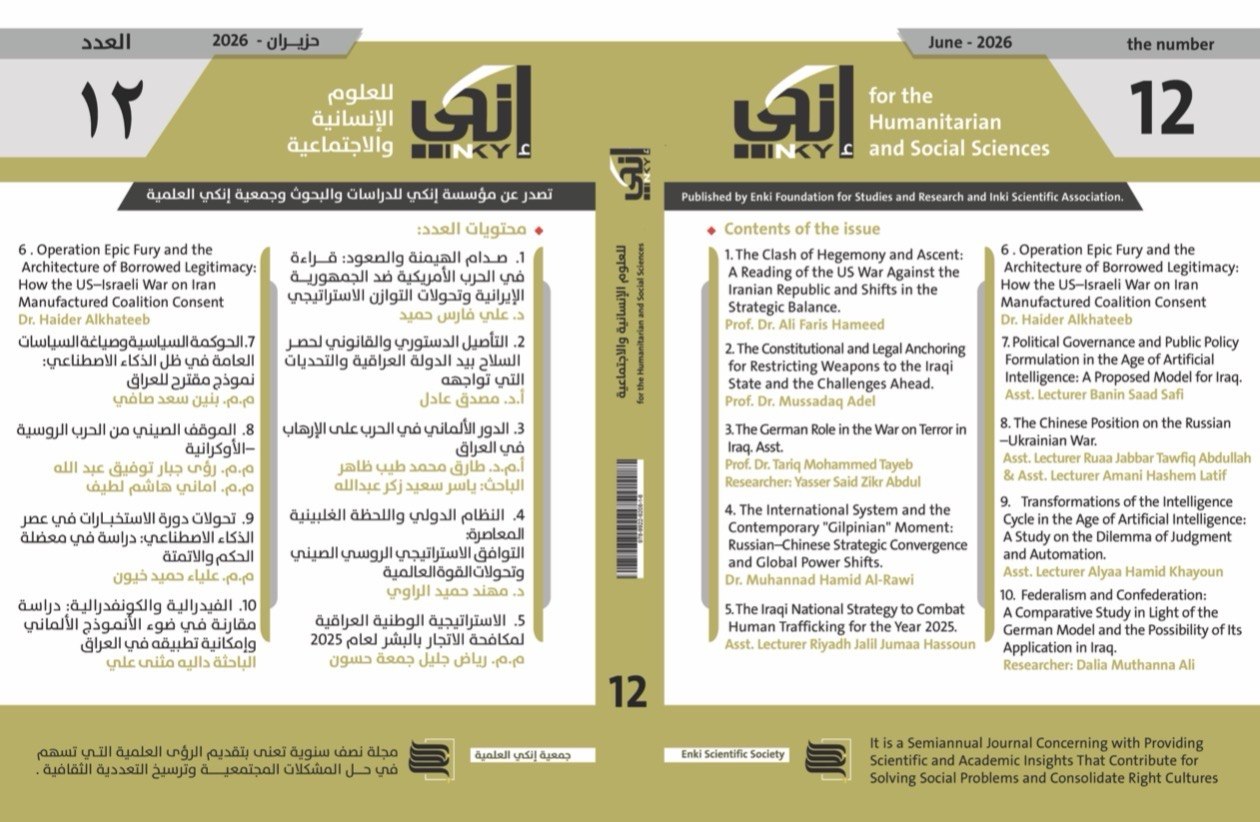
Federalism and Confederalism: A Comparative Study in Light of the German Model and the Possibility of Its Application in Iraq
DOI:
https://doi.org/10.68699/ej012165Keywords:
Germany, Iraq, Distribution of Powers, Political Stability, Federal Relations.Abstract
This research aims to provide a comparative study of federalism and confederalism as two of the most significant political systems used to regulate relationships among political units within a state or among sovereign states. The study examines the fundamental differences between the two systems in terms of their constitutional structures, the distribution of powers and competencies, and their effectiveness in achieving political stability and preserving political unity.
The research focuses on Germany as a successful model of federalism by analyzing the institutional and constitutional features that have contributed to its political stability, particularly the cooperative relationship between the federal government and the Länder (states), as well as the role of constitutional institutions in maintaining a balance between different levels of governance. In contrast, the study explores the experience of federalism in Iraq following 2003 and highlights the major challenges associated with its implementation, including disputes over the distribution of powers, weak institutional coordination, and persistent political disagreements that have affected the effectiveness of the federal system. Furthermore, the study investigates the extent to which elements of the German federal model can be utilized to enhance the Iraqi federal system while taking into account Iraq’s unique political, social, and cultural context.
Downloads
Downloads
Published
Versions
- 2026-09-20 (3)
- 2026-09-20 (2)
- 2026-09-20 (1)
Issue
Section
License
Copyright (c) 2026 Enki for Humanities and Social Sciences

This work is licensed under a Creative Commons Attribution 4.0 International License.
Enki Journal for Humanities and Social Sciences is an open access journal. All content is free to read and download immediately upon publication, without fees or registration. Authors retain copyright in their published work and grant the journal the right of first publication.
This work is licensed under a Creative Commons Attribution 4.0 International License (CC BY 4.0). Anyone may copy and redistribute the material in any medium or format, and adapt and build upon it for any purpose, including commercial use, provided that appropriate credit is given to the author(s) and the original source (Enki Journal for Humanities and Social Sciences), a link to the license is provided, and any changes are indicated.
Full license text: https://creativecommons.org/licenses/by/4.0/