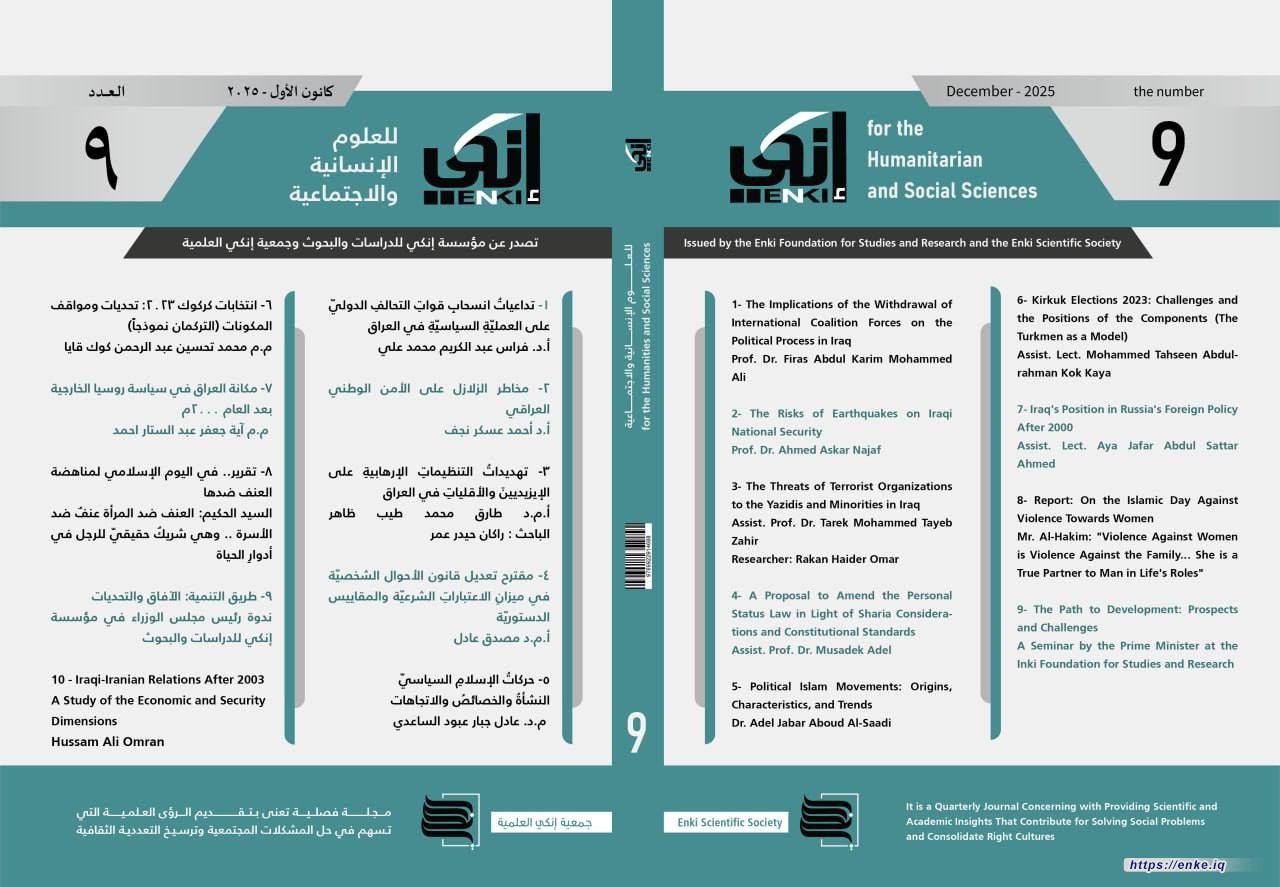
The Position of Iraq in Russia's Foreign Policy After 2000
Keywords:
United States, China, Russia, European Union, Iraq, foreign policy, organizations, alliances, Middle East.Abstract
This research examines Russia's foreign policy and its orientations toward Iraq after the year 2000, as well as the international variables influencing this bilateral relationship. It highlights the strategic significance of Iraq's position and influence in the Middle East, alongside Russia's efforts to integrate Iraq into international organizations and alliances led by China and the Russian Federation, such as the Shanghai Cooperation Organization. Additionally, it discusses Iraq's potential participation in China's Belt and Road Initiative to serve Iraq's economic interests. The research also explores Russia's efforts to extend its influence through regional security alliances, particularly in Iraq, as exemplified by the Quadruple Alliance in the fight against terrorism, involving Russia, Iran, Iraq, and Syria. This strengthens the bilateral relations between Iraq and Russia based on the shared interests of both nations.
Downloads
Downloads
Published
Issue
Section
License
Enki Journal for Humanities and Social Sciences is an open access journal. All content is free to read and download immediately upon publication, without fees or registration. Authors retain copyright in their published work and grant the journal the right of first publication.
This work is licensed under a Creative Commons Attribution 4.0 International License (CC BY 4.0). Anyone may copy and redistribute the material in any medium or format, and adapt and build upon it for any purpose, including commercial use, provided that appropriate credit is given to the author(s) and the original source (Enki Journal for Humanities and Social Sciences), a link to the license is provided, and any changes are indicated.
Full license text: https://creativecommons.org/licenses/by/4.0/