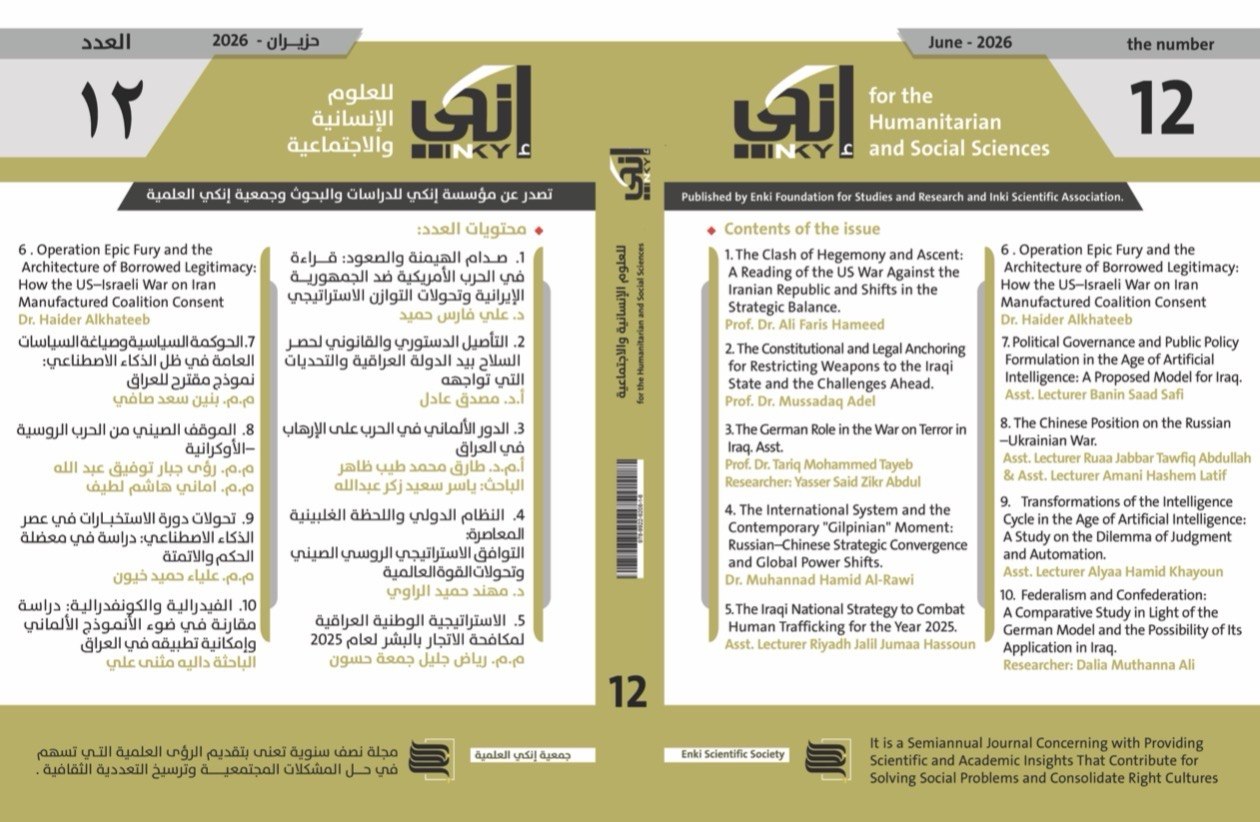
Political Governance and Public Policy Formulation in the Era of Artificial Intelligence: A Proposed Model for Iraq
DOI:
https://doi.org/10.68699/ej012122Keywords:
Political Governance, Artificial Intelligence, Public Policy Formulation, Digital Transformation, Iraq, Predictive Analytics, Smart Government Administration.Abstract
The world is currently witnessing a profound transformation in governance and public policy formulation due to the rapid advancement of artificial intelligence (AI) technologies, which have become fundamental in data management and governmental decision-making. This research aims to analyze the relationship between political governance and artificial intelligence, proposing an integrated model for implementing smart governance principles in Iraq to enhance public sector efficiency and transparency.
The study focuses on four key pillars forming the structural foundation of the proposed model: digital infrastructure, legislative framework, human capacity building, and smart monitoring and evaluation mechanisms.
Using a descriptive-analytical approach, the research concludes that integrating AI into Iraq’s political governance system can improve the quality of public policy formulation, increase institutional performance efficiency, and strengthen citizen trust in governmental administration. It also emphasizes the importance of developing modern legislation, training government staff, and unifying national data platforms to achieve comprehensive digital governance.
Downloads
Downloads
Published
Versions
- 2026-09-20 (2)
- 2026-09-20 (1)
Issue
Section
License
Copyright (c) 2026 Enki for Humanities and Social Sciences

This work is licensed under a Creative Commons Attribution 4.0 International License.
Enki Journal for Humanities and Social Sciences is an open access journal. All content is free to read and download immediately upon publication, without fees or registration. Authors retain copyright in their published work and grant the journal the right of first publication.
This work is licensed under a Creative Commons Attribution 4.0 International License (CC BY 4.0). Anyone may copy and redistribute the material in any medium or format, and adapt and build upon it for any purpose, including commercial use, provided that appropriate credit is given to the author(s) and the original source (Enki Journal for Humanities and Social Sciences), a link to the license is provided, and any changes are indicated.
Full license text: https://creativecommons.org/licenses/by/4.0/