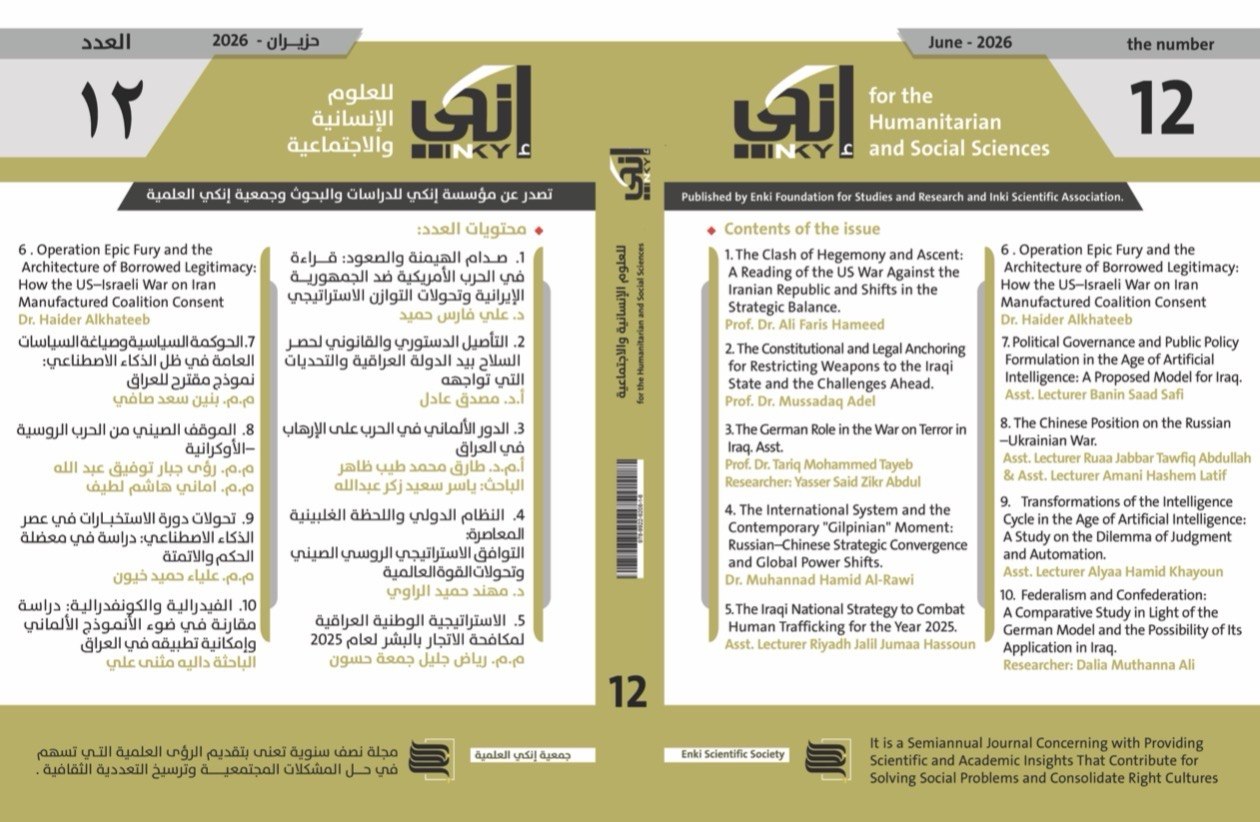
Operation Epic Fury and the Architecture of Borrowed Legitimacy:How the US–Israeli War on Iran Manufactured Coalition Consent
DOI:
https://doi.org/10.68699/ej012094Keywords:
Operation Epic Fury, War of choice, Coalition legitimacy, Nuclear infrastructure, Coalition drag.Abstract
On 28 February 2026, the United States and Israel launched Operation Epic Fury, a coordinated air campaign targeting Iran's nuclear infrastructure, military command structures, and political leadership. Within 48 hours, US Secretary of State Marco Rubio had publicly acknowledged that the operation was predicated not on an imminent Iranian threat to the United States, but on the anticipated consequences of Israeli military action that Washington knew in advance would trigger Iranian retaliation against American forces. This admission is significant. It does not merely complicate the legal justification for the operation; it effectively removes it. And yet the operation proceeded, escalated, and, through a combination of structural pressure, alliance politics and manufactured consequence, succeeded in drawing in partners who had explicitly refused to participate at the outset.
This paper examines that process. It asks how a war of choice, launched without UN Security Council authorisation and predicated on a retroactively constructed casus belli, managed to manufacture the appearance of coalition legitimacy within days of its opening strikes. The paper draws on primary sources, namely Rubio's State Department testimony, parliamentary records, the E3 joint statement, and Arabic-language analytical commentary on Iran's Gulf strategy, together with Patricia Weitsman’s scholarship on coalition warfare and legitimacy. The central argument is that the mechanisms of coalition drag visible in Operation Epic Fury are not accidental or sui generis; they represent a mature institutional logic for converting unilateral wars of choice into legitimised multilateral interventions.
Downloads
Downloads
Published
Versions
- 2026-09-20 (2)
- 2026-09-20 (1)
Issue
Section
License
Copyright (c) 2026 Enki for Humanities and Social Sciences

This work is licensed under a Creative Commons Attribution 4.0 International License.
Enki Journal for Humanities and Social Sciences is an open access journal. All content is free to read and download immediately upon publication, without fees or registration. Authors retain copyright in their published work and grant the journal the right of first publication.
This work is licensed under a Creative Commons Attribution 4.0 International License (CC BY 4.0). Anyone may copy and redistribute the material in any medium or format, and adapt and build upon it for any purpose, including commercial use, provided that appropriate credit is given to the author(s) and the original source (Enki Journal for Humanities and Social Sciences), a link to the license is provided, and any changes are indicated.
Full license text: https://creativecommons.org/licenses/by/4.0/