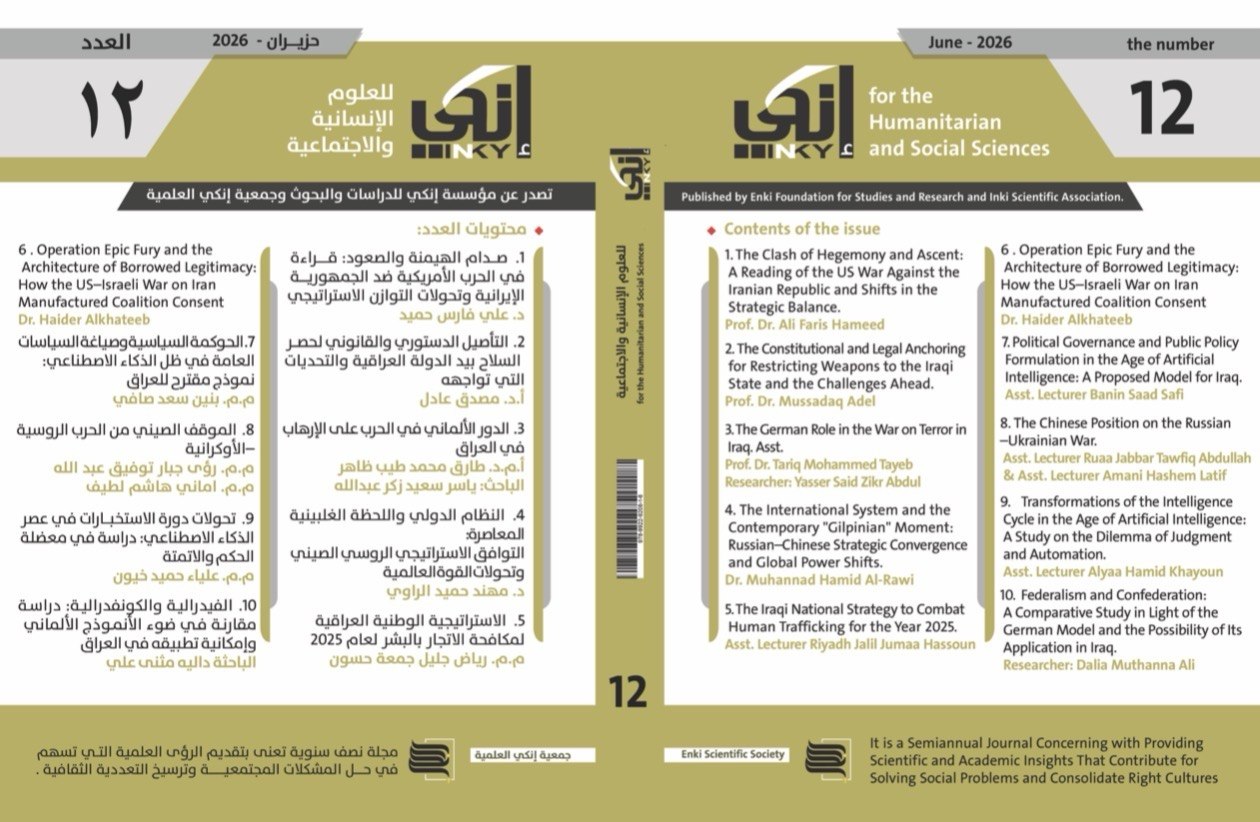
Transformations of the Intelligence Cycle in the Age of Artificial Intelligence: A Study on the Dilemma of Governance and Automation
Keywords:
Intelligence Cycle, Artificial Intelligence, Command Responsibility, Strategic Decision-Making, Hyperwar.Abstract
This study addresses the structural dilemma arising from the acceleration of the intelligence cycle driven by automation and artificial intelligence (AI). It examines the critical implications of shrinking human response time and its subsequent impact on the principle of command responsibility during major international crises. The paper tests a core hypothesis: that the strategic decision-maker has not formally or officially become a hostage to the algorithm, as the role of smart systems remains complementary and supportive. However, any imbalance in this integration formula—whether by blindly succumbing to full automation or neglecting technological capabilities—creates profound gaps in the core pillars of command and legal responsibility (knowledge, intervention, and accountability), which can lead to existential consequences.
Using a case-study approach, the study analyzes two distinct crises: the 1983 Soviet false alarm incident, where human intuition and judgment saved the world from a nuclear war, and the 2020 downing of the Ukrainian airliner in Iran, which exemplifies strategic failure when automation eclipses and empties the human window of intervention.
The study concludes that while algorithms serve as a "capability multiplier" in data collection and classification, they remain inherently incapable of reading intentions, understanding context, or bearing moral responsibility, making the human element indispensable for strategic judgment. The paper recommends establishing an organizational balance model to prevent the phenomenon of "outsourcing responsibility" or hiding behind algorithmic objectivity to justify critical security decisions.
Downloads
Published
Versions
- 2026-06-21 (2)
- 2026-06-21 (1)