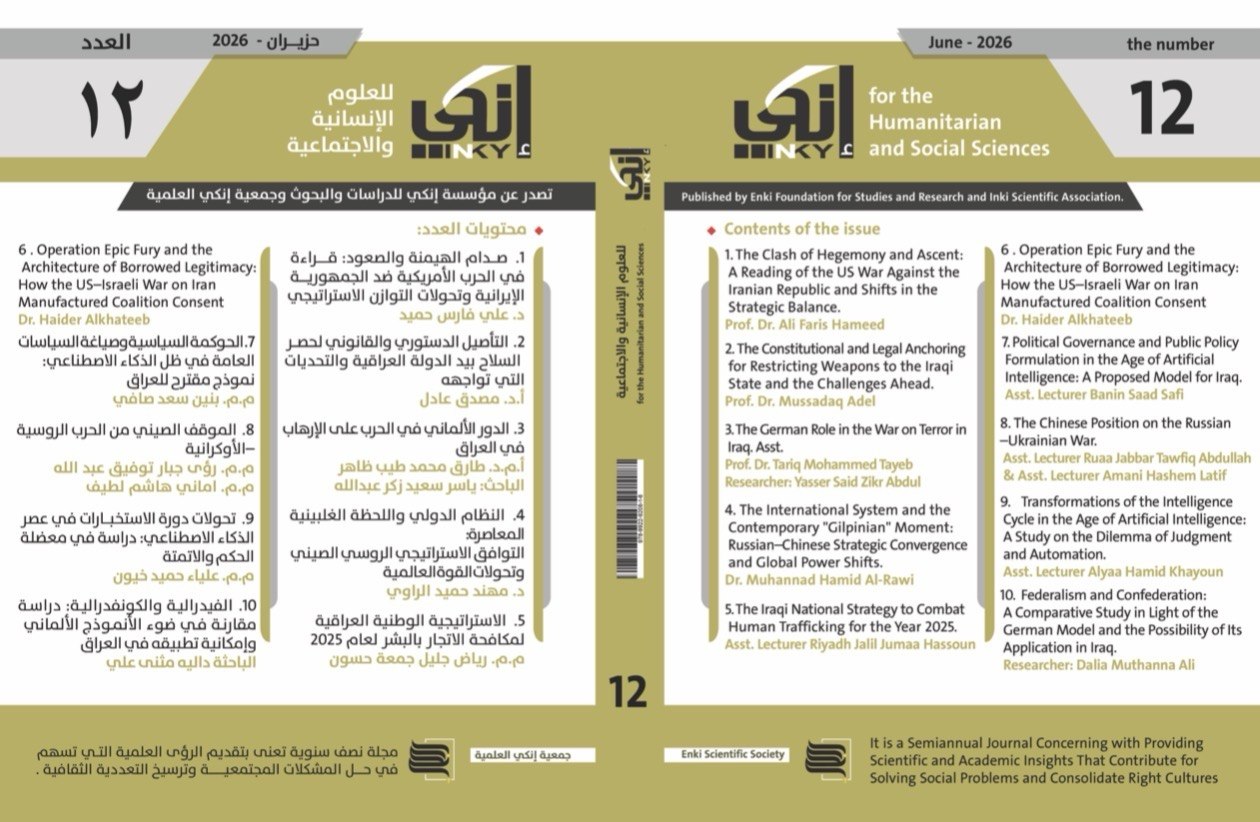
The Clash of Hegemony and Rise: A Study of the American War Against the Islamic Republic of Iran and the Transformations of the Strategic Balance
Abstract
This study examines the American Iranian conflict as one of the most complex conflicts within the contemporary international and regional environment by analyzing its theoretical, geopolitical, and military dimensions within the framework of power transformations in the Middle East. The study is based on the central assumption that this conflict is no longer managed through conventional patterns of warfare; rather, it increasingly relies on hybrid warfare, asymmetric deterrence, proxy wars, as well as economic and cyber confrontation, amid the declining effectiveness of unilateral American hegemony and the rise of regional powers capable of reshaping strategic balances.
The study employs the theories of power transition, long cycles, and the Thucydides Trap, while adapting them to the specific characteristics of the Middle Eastern environment in order to interpret the dynamics and recent transformations of the American–Iranian conflict. It also discusses the nature of Iranian military doctrine, the role of regional proxies, and the significance of maritime geography and energy resources in constructing new deterrence equations.
The study concludes that the Middle East is witnessing a gradual transition from the phase of unilateral American dominance toward a more complex regional and international order based on multiple centers of power. It further argues that Iran has succeeded, through asymmetric deterrence strategies, in reducing the traditional power gap with the United States and imposing itself as a major actor in regional security equations, reflecting a structural transformation in the nature of both the regional and international order.
Downloads
Published
Versions
- 2026-06-21 (2)
- 2026-06-21 (1)