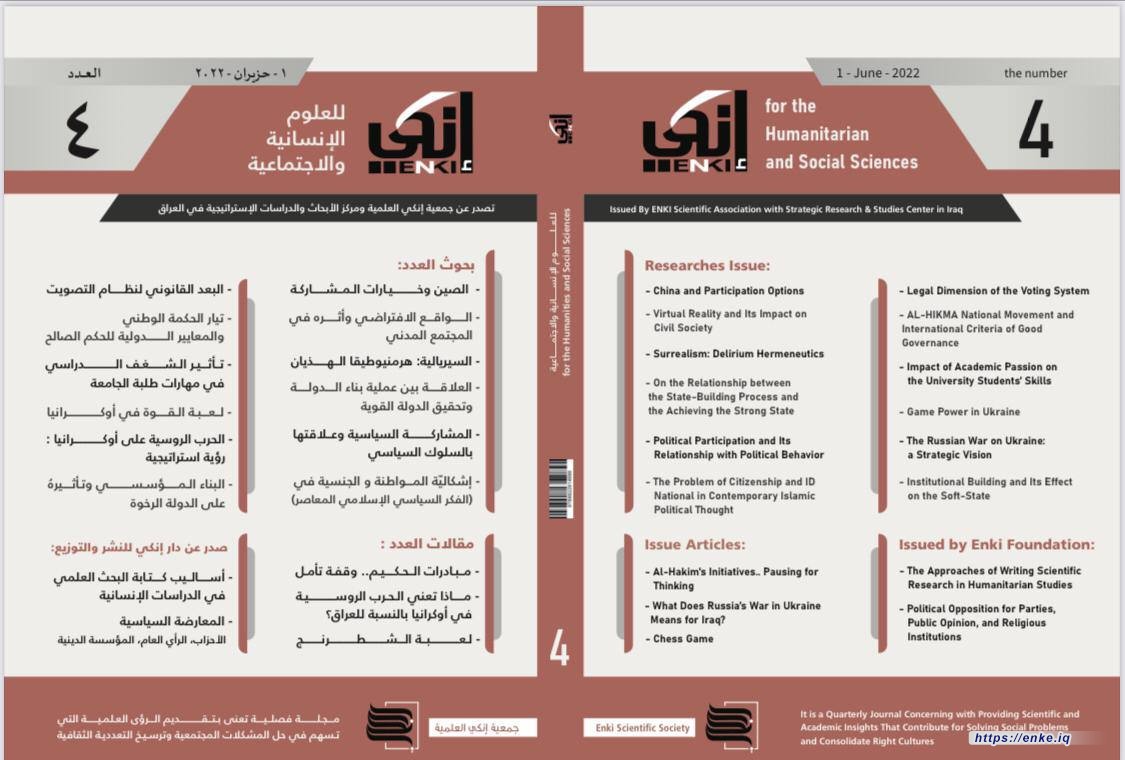
Institutional Building and Its Impact on the Soft State
Keywords:
Soft State; Failed State; Institutional Building; Political Stability; Political Institutions.Abstract
This study examines the concept of the soft state and its causes and indicators, focusing on the relationship between institutional building and state stability and preventing the transformation of states into soft or failed states. The study is based on the hypothesis that institutions play a fundamental role in building the state and preserving its political, economic, social, and security foundations.
The study reviews Gunnar Myrdal's concept of the soft state as a state that possesses legal and legislative frameworks but lacks the ability to implement them effectively and fairly. Such states are characterized by corruption, weak rule of law, and the predominance of elite interests over the public interest. The study also discusses related concepts, including weak, failed, collapsed, fragile, and deep states, highlighting the differences among them.
Furthermore, the study analyzes the stages through which states progress toward failure and collapse, from weak states to failed states and eventually collapsed states. It also identifies political, security, economic, constitutional, social, intellectual, and cultural indicators of state weakness, including declining legitimacy, deteriorating public services, widespread corruption, poverty and unemployment, educational and cultural decline, illiteracy, demographic pressures, migration, and displacement.
The study concludes that building strong and effective formal political institutions based on constitutional principles, the rule of law, efficiency, and institutional independence constitutes a necessary condition for achieving political stability and comprehensive development, enhancing the state's capacity to address internal and external challenges, and preventing its transformation into a soft or failed state.